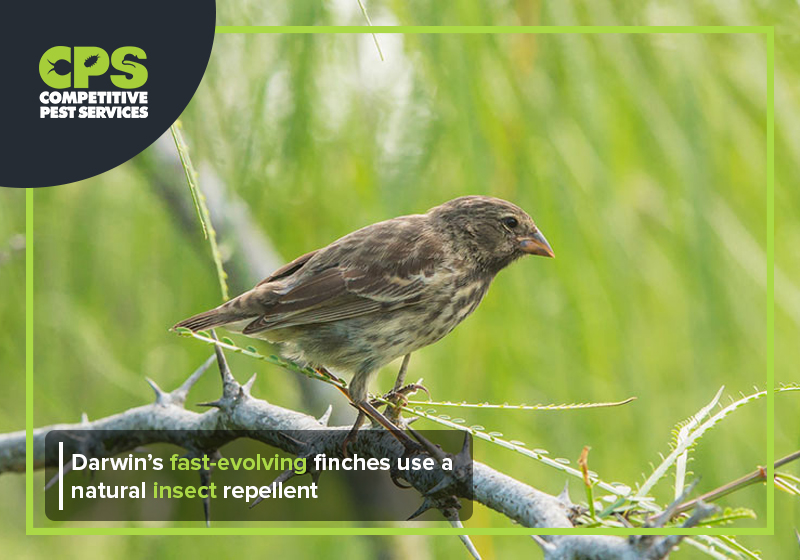
Darwin’s finches are plagued by Stowaway disease carrying mosquitoes and by the parasitic fly Philornis downsi brought to the Galapagos Islands on tourist planes, whose larvae can kill entire broods of young birds, there is often 100 per cent mortality in nests said Charlotte Causton of the Charles Darwin Foundation in Puerto Ayora on Santa Cruz Island. The fly lays its eggs at the base of a finch nest and when the larvae develop they suck the blood of the nestlings.
But now the songbirds are fighting back. Sabine Tebbich of the University of Austria in Vienna and her colleagues noticed that birds from four species of Darwin’s finches were picking leaves from a Galapagos guava tree, Psidium galapageium, and rubbing them into their feathers. The leaves turned out to repel mosquitoes and inhibit the growth of the parasitic larvae, the team reported last month at the Behaviour 2015 meeting in Cairns. “This is the first time that Darwin’s finches or any other species of Galapagos songbird have been reported conducting this kind of behaviour,” she says.
Other birds and animals around the world are known to rub their feathers or fur with plants to protect themselves from insects and parasites, but observations of this behaviour in birds are mostly anecdotal. Although thwy do not know if the insect repellent is a recently developed response to parasites or something the birds have done for a long time. Philornis downsi was introduced accidentally in the 1960s and its negative impact on finches was first noticed in the 1990s. Click here to read the full Story.
Read More: