Send us a message and one of our specialists pest managers will be in touch
Why Rats Are Getting Smarter: Bait Resistance in Australian Rodent Populations
June 7, 2026
Rats are not easy pests to outsmart. They have a high sensitivity and are able to detect a dangerous environment. They scan the environmental conditions, and even communicate with each other to make a nest near a rat hole beside the buildings or group together near dry and warm places like an attic. How to control rats effectively while no harmful activity to the wildlife predators? Most of the poisoned rats’ internal body cells release the toxins […]
Rats are not easy pests to outsmart. They have a high sensitivity and are able to detect a dangerous environment. They scan the environmental conditions, and even communicate with each other to make a nest near a rat hole beside the buildings or group together near dry and warm places like an attic.
How to control rats effectively while no harmful activity to the wildlife predators?
Most of the poisoned rats’ internal body cells release the toxins after being killed with chemical products, in which some predator animals, like eagles and owls, might prey on. This can lead to unnecessary damage to these predators, and even death can occur.
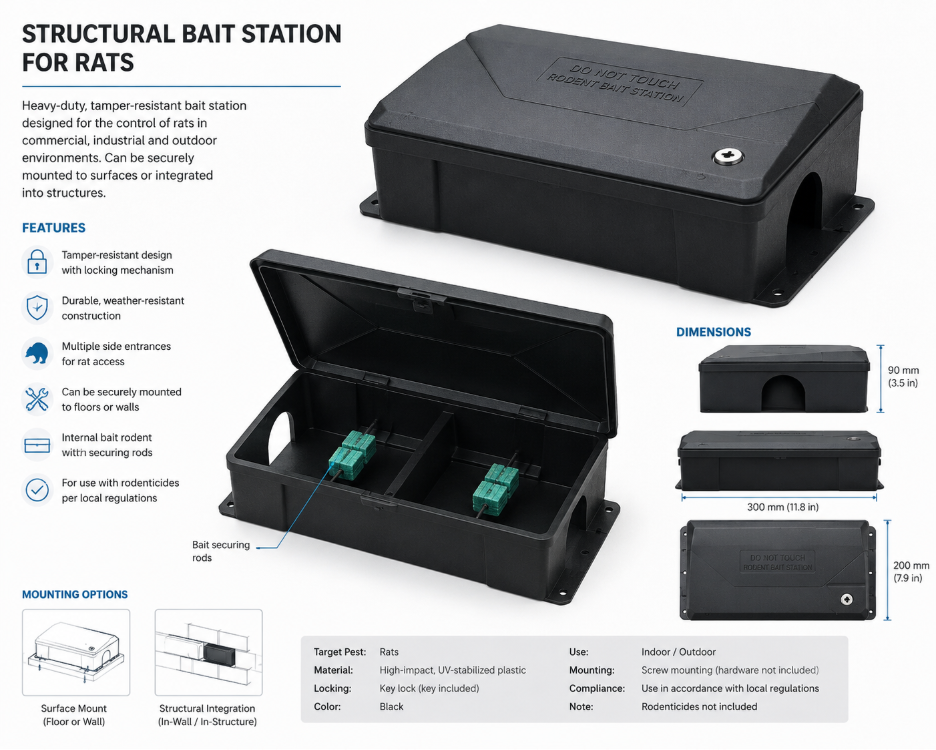
In this case, structural baiting systems are critical as it sythesizes with the advanced technology and rodenticides skills. This can significantly reduce from killing predators.
Which areas are the best places to install baiting stations?
Rat populations are approximately hundreds of millions across the country, and 60 native species. However, mostly, they live underneath the grounds as it can protect them against weather conditions and human threats.
Integrated Pest Management (IPM), which is widely applied in controlling different pests. Instead of relying on a single toxic solution, IPM uses a layered strategy to make your property an unwelcoming environment for rodents.
In controlling rats, there are three types of use cases to protect against rats:
1. Mechanical Traps
Snap traps: a traditional method to catch rats, spring-loaded bar traps. They are highly effective, cost-efficient, and instantly lethal when used correctly.
Multi-catch trap: requires one-time setup, multiple mice can be caught sequentially without resetting, and is suitable for sensitive areas like food plants.
2. Monitoring & Detection
Digital bait traps: empty, non-toxic bait blocks placed to monitor the rats’ activity in common areas without committing to a toxic control plan.
Infrared & Motion sensors: These traps allow you to track rats’ footprints, identify rat species, and map trail lines without using poisons.
3. Exclusion & Structural Devices
This method can prevent rats from entering your property. It is useful to install food manufacturing production sites, where rats are most likely to engage.
Door Sweeps: rubber or nylon brushes installed at the bottom of the door to block ½ inches gap that rats or mice use to squeeze indoors.
Hardware Cloth: woven, galvanized steel screens used to cover vents, chimneys, and larger holes to prevent rodents from chewing through.
Rotation: Never rely on the same product indefinitely. Rotating your control methods prevents rats from adapting to a single strategy.
The Ripple Effect: Risks to Our Wildlife
Rodent control doesn’t happen in a vacuum. When we rely heavily on anticoagulant rodenticides, we put non-target species at risk. Native birds of prey, owls, reptiles, and small mammals can be harmed through primary poisoning (eating the bait directly) or secondary poisoning (consuming a rodent that has ingested the toxin).
In Australia’s delicate ecosystem, we have a responsibility to move away from indiscriminate toxic baiting. Commercial and residential sites must prioritize methods that minimize environmental impact while maximizing control.
Strategy Over Chemicals
Rats are among the most intelligent mammals, and they are excellent at adapting to our attempts to control them. If your current baiting program is failing, the solution isn’t more poison—it’s a better strategy.
By shifting our focus toward proofing, sanitation, and intelligent monitoring, we can effectively manage rodent populations while protecting our native wildlife. Long-term control begins with understanding why your current methods are failing and pivoting to a more sustainable, science-backed approach.
Are you tired of baiting without results? If your current rodent control program feels like a losing battle, it’s time for a professional perspective.
Contact us today to arrange a resistance-aware rodent inspection and discover how a smarter, IPM-based strategy can protect your property and the local environment.
Contact CPS today to arrange a professional inspection and tailored treatment plan.
We acknowledge the Traditional Custodians of Country throughout Australia and their connections to land, sea, and community.
We pay our respect to their Elders past and present and extend that respect to all Aboriginal and Torres Strait Islander peoples today.