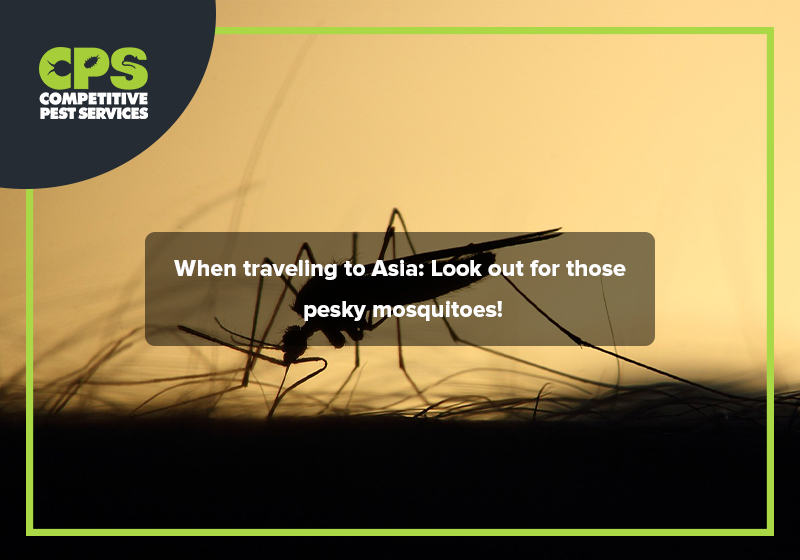
Mosquito in Asia
A Victorian man visiting Thailand has died from the rare virus Japanese encephalitis.
Summary:
- A 60 year old man contracted the disease by what is to be believed as a mosquito bite.
- JE is a rare disease that affects around 1 out of 500,000
- If traveling to Asia, take precaution in protecting yourself through vaccinations and simple insect repellant.
It is believed to only be the 10th case of the disease recorded in Australia and the second case reported in Victoria.
The man in his 60s had visited Phuket for 10 days in early May and began to feel lethargic on day eight. After returning home he struggled to stay awake and was admitted to hospital a few days later in a confused state. He was eventually admitted to the intensive care unit, where he died. It’s believed the man was from Shepparton in the state’s north.
Japanese encephalitis occurs in China, south-east Asia and Indonesia.
Symptoms, which include headaches, a fever, convulsions and focal neurological signs, appear between 5 to 10 days after being infected.
Japanese encephalitis can cause a brain infections and is fatal in about 20 to 30 per cent of cases.
It can cause long-term neurological complications in up to half of cases.
Experts say the virus cannot be passed from person to person.
Although the mosquitoes capable of carrying the virus exist in Victoria, there was minimal risk that the virus would spread because the virus multiplies in pigs.
Royal Melbourne Hospital doctor Steven Tong, who treated the man, said mosquitoes carry the virus and the risk of catching it overseas is “very low” but varied based on destination, duration of travel, season and activities.
“The virus is maintained in a cycle involving mosquitoes and vertebrate hosts, mainly pigs and wading birds. People can be infected when bitten by an infected mosquito but most people are asymptomatic or display only mild symptoms.”
Only a small percentage of infected persons develop inflammation of the brain also known as encephalitis.
Figures suggested that for travelers to endemic areas such as Thailand, the risk is about one in a million to one in 500,000 travelers of those who travel to such areas.
The most recent national tourism statistics from the Australian Bureau of Statics revealed more than 620,000 Australians travel to Thailand each year.
Doctors urge any Australians traveling to Asian countries to discuss getting the vaccination for the disease and other health risks with their general practitioner.
People are also urged to always use insect repellent when traveling abroad.
There were no reports the man had contact with animals or traveled to rural regions in Thailand, but he had been bitten by mosquitoes a number of times.
The last known case of Japanese encephalitis in Australia was in 2015 when another Victorian man aged 45 returned with the disease after a trip to Bali.
Australians travelling anywhere in south-east Asia should take precautions, including vaccination and the use of insect repellent.
The first ever outbreak of Japanese encephalitis in Australia occurred in the remote outer islands of the Torres Strait in 1995, with three cases – two of them fatal.
Read Our Other Posts