Send us a message and one of our specialists pest managers will be in touch
What No One Tells You About Pest Control in Strata Buildings
June 9, 2026
In strata buildings, most of the homeowners often participate in the regular maintenance for sustainability, which includes pest control and creating hygienic environments. Strata pest control is important for various reasons, such as maintaining a good reputation in your residential areas and a high-density population across shared walls. Who is this blog post for? In modern house management, strata […]
In strata buildings, most of the homeowners often participate in the regular maintenance for sustainability, which includes pest control and creating hygienic environments. Strata pest control is important for various reasons, such as maintaining a good reputation in your residential areas and a high-density population across shared walls.
Who is this blog post for?
In modern house management, strata complex maintenance is critical for strata managers, owner corporations, and property managers.
Why is the Strata Pest Control Process more complex than you think?
Pest control in strata buildings is different from that in a standalone residential building because it requires extra attention to detail, and consistent maintenance is critical for every resident. However, technicians made mistakes in strata buildings because they treated the pest as residential. In this case, what pest controllers can perform is implement an interconnected ecosystem and the complex pest control process.
Some of the technicians might skip these areas:
Elevator Shafts and Lift Pits: Some pest technicians might overlook the bottom of the elevator pits, where most of the mice and insects often hide in the warm grounds. Consequently, they easily travel from the ground to the executive office’s front door.
Plant Rooms and Mechanical Voids: They might hop the server, electrical rooms. Why? The building manager doesn’t provide the key to enter, resulting in later consequences, such as mice and insects using them for nesting, even though they chew the expensive fiber cords, causing the server center downtime and fire hazards.
Suspended Ceiling: Often, mice travel through the ceiling grids, in which it provides for the potential nesting areas. Also, pest experts might put the bait stations on the floor and office baseboards, while ignoring the massive space above ceiling tiles.
These hidden areas are usually overseen, and the complex building structure has a higher chance of pest issues.
Why are pest infestations easy to spread?
Once a small infested area breaks out, multi-site infestation takes hold within days to be widespread. Common access points, where pests can easily enter:
Shared walls, where they have warmth and coziness, nesting areas for rats, mice, and insects. Due to the good insulation in wall cavities, they can breed and travel from one point to another, and humans won’t notice their pest activities.
Plumbing: the inside of drains accumulates a layer of slime, made of grease, hair, and organic waste. Drain flies and sewer roaches feed and lay eggs, usually inside the sludge.
Bins areas, where an endless food supply can be simply retrieved by mice and insects. Harborage points: stacked bins, discarded cardboards, and dark corners provide excellent hiding spots where pests can multiply undisturbed.
In many strata buildings, repeated complaints from different units usually indicate a larger building-wide issue rather than an isolated infestation.
This is why some residents feel frustrated after treatment because pests return weeks later. If surrounding units or common property areas still contain active harbourage, the infestation often spreads back into the treated lot.
“Coordinating with the pest technicians, proper communication, and follow-up questions for effective pest control. “
Who Is Responsible for What
One of the most common sources of confusion in strata pest control is the responsibility. The legal framework in Australian strata legislation is generally clear, but the practical application in a mixed-infestation scenario rarely is.
Owners corporations and bodies corporate are typically responsible for pest management in common property. This includes hallways and lobbies, basements and car parks, bin rooms, shared gardens, roof spaces, lift areas, and common service zones.
Professional inspections also help determine whether the source of activity is isolated or connected to the wider building structure.
Why Spot Treatments Consistently Fail in Strata Settings
If you have lived in a strata building and had your apartment treated for cockroaches or rodents, you have experienced the spot treatment failure first-hand. It is not a product quality issue. It is a program design issue.
Treating one apartment while leaving the shared pathways that connect it to the rest of the building untouched provides temporary relief.
The pests that were present in the treated lot move through the wall or ceiling into an adjacent space during treatment and return once the chemical barrier degrades, typically within four to six weeks. Nothing in the treatment addressed why the population existed or how it was being sustained.
Cockroaches in strata buildings typically move through pipe penetrations, drainage systems, shared wall cavities, and ceiling voids.
Rodents use roof voids, utility shafts, subfloors, and service corridors. Neither species recognises human intervention.
The alternative is a coordinated program:
A whole-building inspection that maps activity across common property and individual lots
a treatment plan that addresses the movement pathways rather than just the occupied zones
a monitoring schedule that confirms the program is working across the building rather than simply confirming that the treated lot remains clear.
Pest Management Process
Effective strata pest management focuses on prevention before infestations spread through the building. Long-term control includes regular inspections, monitoring, fast repair of leaks and entry points, proper waste management, routine cleaning of shared areas, and reducing clutter and cardboard storage. Resident communication and early reporting also play an important role. Preventive maintenance is far more effective and less expensive than waiting until pest complaints become widespread.
Buildings with organised maintenance programs usually experience:
Fewer infestations
Lower treatment costs
Better hygiene standards
Reduced resident complaints
Stronger long-term pest control outcomes
When to Call a Professional
Professional pest management is recommended:
If pests appear across multiple units
If rodents are active in roof spaces or basements
If the building requires a coordinated treatment plan
Large strata properties often need full-building inspections to identify:
Hidden harbourage
Structural access points
Moisture-related risks
Pest movement pathways
High-risk common areas
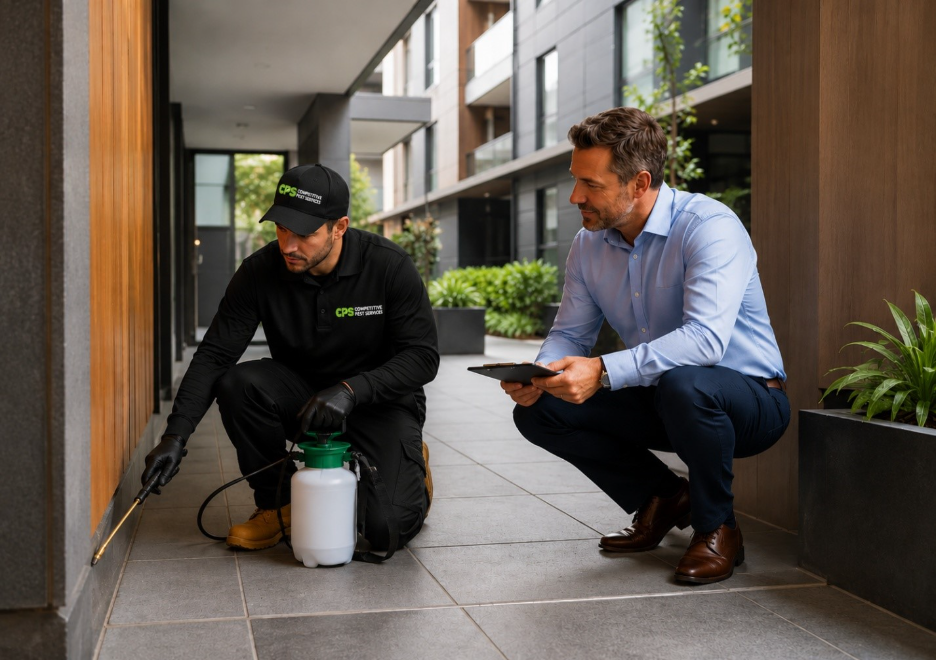
CPS provides full-building strata inspections across Melbourne, Sydney, Brisbane, and Perth, with written reports structured for use in owners corporation meetings, strata committee communications, and compliance documentation.
If pest activity keeps returning in your strata building, the problem may be larger than a single unit.
Arrange a full-building inspection with Competitive Pest Control to identify hidden pest pathways, common property risks, and long-term prevention solutions before the infestation spreads further.
Contact CPS today to arrange a professional inspection and tailored treatment plan.
We acknowledge the Traditional Custodians of Country throughout Australia and their connections to land, sea, and community.
We pay our respect to their Elders past and present and extend that respect to all Aboriginal and Torres Strait Islander peoples today.