Send us a message and one of our specialists pest managers will be in touch
Bird Control Australia: Netting, Spikes & Prevention | CPS
May 21, 2026
Bird control is key to maintaining clean, safe spaces free from damage and health risks. Effective, humane solutions help protect your property and enhance your surrounding environment. There are numerous number of birds from landing, that most of the birds can be prevented by exclusion methods like bird netting, and bird spikes. Though bird control solutions can be handled by […]
Bird control is key to maintaining clean, safe spaces free from damage and health risks. Effective, humane solutions help protect your property and enhance your surrounding environment.
There are numerous number of birds from landing, that most of the birds can be prevented by exclusion methods like bird netting, and bird spikes. Though bird control solutions can be handled by professional bird controller, some bird species like pigeons are harder to manage because they have higher reproductive rate compared to other bird species.
Native birds such as Native birds such as the Australian Magpie, Great Horned Owl, Hooded Pitohui, Harpy Eagle, African Crowned Eagle, and Common Ostrich each have distinct characteristics and features:
Australian Magpie: Striking black and white plumage; known for its melodious song.
Great Horned Owl: Prominent ear tufts; powerful talons; deep hooting call.
Hooded Pitohui: Bright orange and black coloration; one of the few poisonous birds due to toxins in its skin and feathers.
Harpy Eagle: Large and powerful raptor; massive talons; distinctive feathered crest.
Common Ostrich: Largest living bird; flightless; long legs adapted for fast running; large eyes for keen vision.
They are regarded as the most dangerous species to human habitation, nevertheless, many people widely to consider using like bird proof netting to prevent bird infestations. Using these bird deterrent by professional bird control solutions, many birds from landing can be effectively deterred.
Legislation for pest bird species
Most native birds in Australia are protected under state legislation, such as the Biodiversity Conservation Act 2016 in NSW. In Australia, it is crucial to use humane methods that do not harm native species, as many are protected by law. The Environment Protection and Biodiversity Conservation Act 1999 provides federal protection for listed migratory and endangered species.
What are the effective bird deterrent methods and bird control solutions?
Local councils handle localized management issues, particularly with overabundant bird species in public spaces. Effective bird control in Australia involves a combination of exclusion, physical deterrents, and sensory scarers.
Visual deterrents use reflective surfaces or predator decoys to create an effective control by making birds perceive a threat, discouraging them from landing or nesting on commercial buildings, solar panels, or monuments.
Acoustic devices emit high-frequency sounds that are inaudible to humans but cause pest birds like pigeons and common mynas to vacate urban areas and shopping centres.
Laser technology provides a cost effective solution by projecting moving beams of light that act as an effective deterrent, especially during breeding season, to stop birds from accessing unwanted areas such as agricultural sites or city streets.
These are the bird proofing methods and effective bird control solutions from bird damage while minimizing the risks of health concerns. Bird spikes are considered to be a humane deterrent method that prevent from specific areas, effectively reducing property damage and health risks associated with bird droppings.
Pest birds can pose serious health risks by carrying transmittable diseases such as psittacosis, salmonella, and pseudo-tuberculosis, which can affect humans. Nesting materials from birds can create fire hazards and block gutters, leading to water damage during heavy rains.
Nonetheless, urban pigeon pest control are common pests due to the pigeon droppings are corrosive to the solar panels and commercial properties, which can significantly damage the building in the long-terms.
Bird control services like installing bird netting are highly successful to stopping these bird problem and other pests.
Professional bird netting is a versatile and non-lethal method that provides a physical barrier to keep birds out of specific areas, such as warehouses and outdoor structures, without harming them.
Common nesting areas that native species like
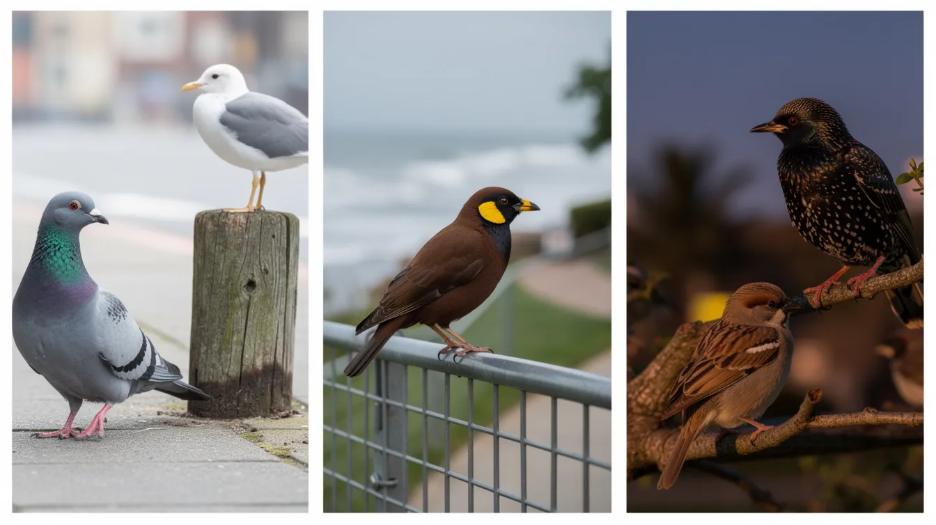
Pigeons, often referred to as ‘rock doves’, are notorious for nesting on artificial structures like buildings and solar panels, leading to significant property damage due to their corrosive droppings.
Sea Gulls, known as ‘Silver Gulls’, are highly adaptable scavengers that can become a nuisance by raiding bins and pestering humans for food, particularly in coastal areas.
The Common Myna, an introduced species in Australia, is known for its aggressive behavior towards native birds and can create unsightly nests using various materials, including human rubbish.
House Sparrows, introduced from Britain, thrive in urban environments and can become pests by nesting in buildings and foraging for food in canteens and other areas.
Common Starlings, which can be aggressive and territorial, often nest in roof voids and walls of human structures, leading to property damage and competition with native species.
Bird Netting and Bird Proof Netting
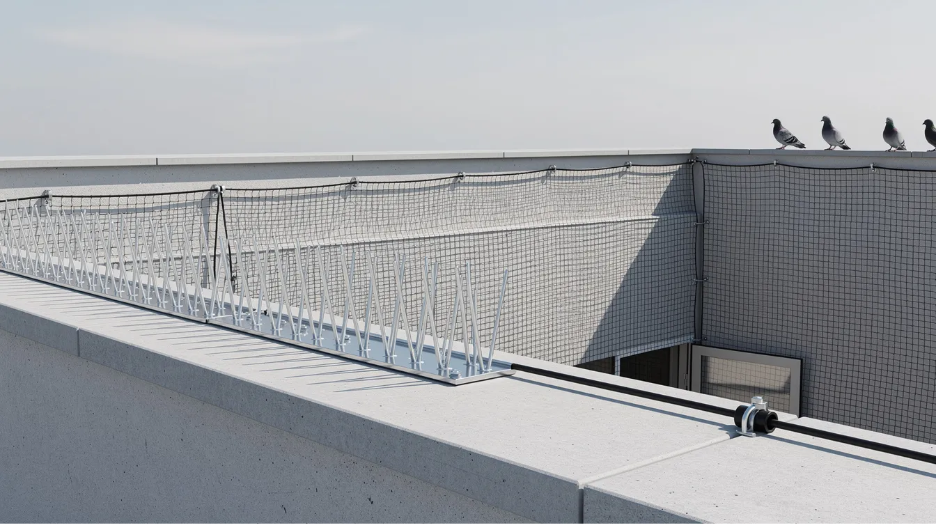
Bird netting is a key exclusion method to keep birds from nesting and damaging properties. It protects agricultural sites, monuments, commercial buildings, and homes from pest birds like pigeons and mynas.
Bird proof netting and bird spikes are essential tools in bird control strategies. The netting acts as a physical barrier that stop birds from accessing and nesting in unwanted areas, protecting agricultural sites, monuments, commercial buildings, and residential properties from damage caused by pest birds such as pigeons and mynas.
Bird spikes serve as a humane deterrent by making surfaces uncomfortable for birds to perch or roost on, effectively discouraging their presence without causing harm. Together, these methods provide a comprehensive approach to managing bird problems while preserving the visual appeal and structural integrity of your property.
Key product types and features:
Polyethylene Netting: Durable, UV-resistant, ideal for large outdoor areas.
Stainless Steel Wire Netting: Strong and long-lasting for high-risk spots.
Custom-Fitted Netting: Tailored to fit specific structures without harming aesthetics.
Seagull Netting: Smaller mesh to block smaller birds in sensitive areas.
Professional Installation: Ensures secure fitting and gap prevention.
Combined Methods: Often used with spikes and visual deterrents for full protection.
Installing bird netting helps prevent damage, disease, and fire hazards caused by birds, offering a safe, effective alternative to chemicals or DIY solutions.
Ongoing bird control expertise
Community engagement programs involve citizens in monitoring bird populations and enhancing habitats. Ongoing monitoring and maintenance are essential in bird control services to ensure long-term effectiveness and to adapt strategies as needed based on changing bird activity.
Regular inspections and maintenance help identify new nesting sites and potential risks, allowing for timely interventions to prevent bird-related damage.
Professional bird control humane techniques
Some Professional bird control like generalist, tend to discourage birds, using bird deterrent methods, as I mentioned above, these pest controllers mustn’t use harmful chemicals to native species, which is not only causing loss of biodiversity but also risks of penalty fee concerns.
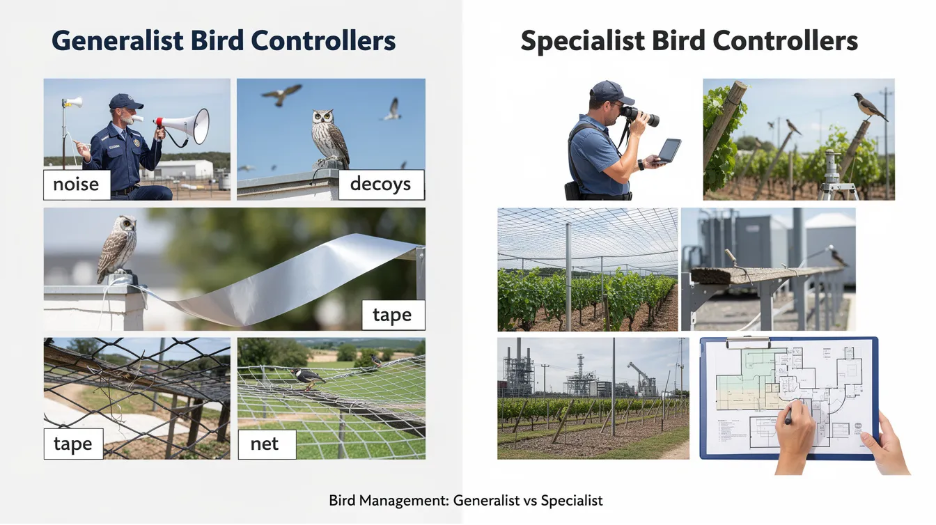
Generalist vs Specialist Bird Controllers
There are two types of bird controllers such as general controller and specialist/ license bird controller. If the bird infestations are uncontrollable situations, specialist, who can legally perform “prohibited acts” that standard controllers cannot. Let’s look at the distinction between these technicians:
Standard License vs Specialist Wildlife Controllers
In bird control Australia, understanding the differences between standard license holders and specialist wildlife controllers is essential for effective and legal bird management. Each type of controller targets specific bird species and employs particular methods under different regulatory requirements.
Aspect
Standard License Controller
Specialist Wildlife Controller
Primary Species Targeted
Common pest birds such as feral pigeons, Indian myna, house sparrows, and common starlings
Protected or problematic species requiring special permits, including native raptors, owls, and other protected birds
Target Species
Problem birds causing significant damage or health hazards in urban and agricultural settings
Native species under protection or species causing severe ecological impact
Methods Used
Installation of bird spikes, bird netting, visual and acoustic deterrents, exclusion methods
Use of humane capture, relocation, and in some cases, controlled removal under legal authority
Requirements
Standard pest control license with training in bird control; adherence to state and federal wildlife protection laws
Under the Authority to Control Wildlife (ATCW); advanced training and compliance with strict regulations
Scope of Work
Residential and commercial bird control, focusing on exclusion and deterrence
Complex wildlife management including rehabilitation, relocation, and legal culling where necessary
Legal Considerations
Must avoid harm to protected native birds; limited to non-lethal control methods
Authorized to perform “prohibited acts” under specific conditions with government approval
Choosing the right type of bird controller depends on the species involved and the severity of the bird problem. For common pest birds like feral pigeons and Indian mynas, standard licensed controllers can effectively manage populations using exclusion and deterrent methods such as bird netting and spikes. However, for protected native species or complex situations requiring removal or relocation, specialist wildlife controllers with appropriate permits and expertise are necessary to ensure compliance with Australian wildlife legislation.
Ready to protect your property from bird damage?
Need help protecting your property from bird damage? CPS can assess nesting, roosting, droppings, and entry points, then recommend humane bird control solutions such as netting, spikes, and exclusion systems.
We acknowledge the Traditional Custodians of Country throughout Australia and their connections to land, sea, and community.
We pay our respect to their Elders past and present and extend that respect to all Aboriginal and Torres Strait Islander peoples today.